

Watch: Charting the Structure of Emergence – A Critique of Ken Wilber’s 4Q Model of Evolution

Dear Friends of Developmental Philosophy,
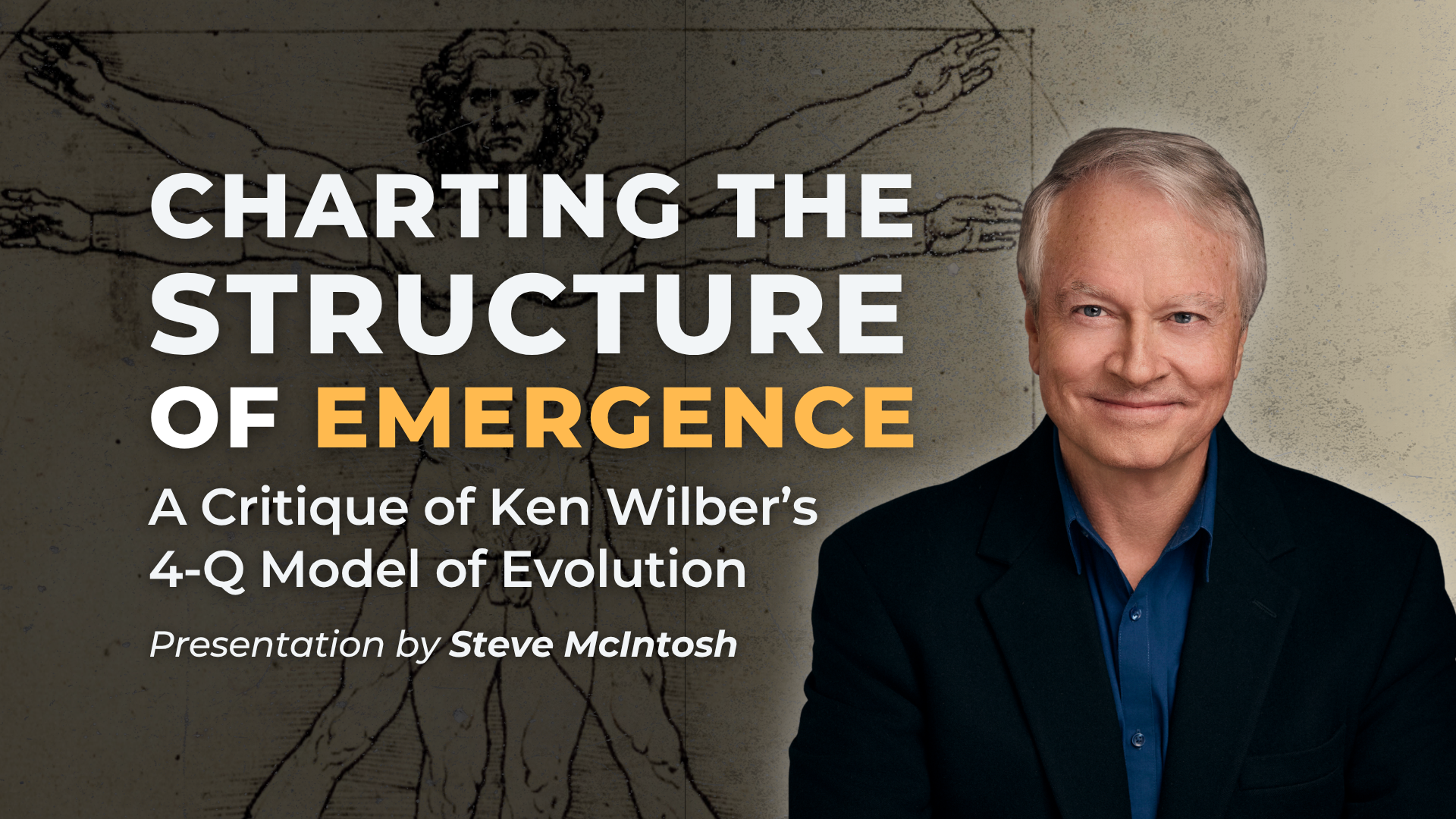
In this talk with our monthly Zoom group, developmental philosopher Steve McIntosh examines evolution’s structure of emergence—the sequence of integrated levels that connects each of us to the beginning of the universe. Steve starts by examining humanity’s various attempts to chart this evolutionary structure, including Ken Wilber’s ambitious 4-Quadrant model. After critiquing Wilber’s model, Steve then considers how improving our understanding of evolution’s overall structure-process can help us meet the challenges of our time in history. The presentation concludes with questions from the audience.
Steve McIntosh is a philosopher of noosphere evolution. Influenced by the philosophy of Alfred North Whitehead and Pierre Teilhard de Chardin, his work focuses on understanding intrinsic value and furthering the development of human culture. Writing in the emerging field of developmental philosophy, McIntosh has authored four books: Developmental Politics (2020), The Presence of the Infinite (2015), Evolution’s Purpose (2012), and Integral Consciousness and the Future of Evolution (2007). His fifth philosophy book, Truth Emerging, will be published by Orbis Books in September, 2026. Since 2013, McIntosh has served as cofounder and president of the Institute for Developmental Philosophy.
Watch replay here: https://youtu.be/z9D8TtB7er0
Click here to join Steve McIntosh’s monthly Zoom group and to receive Zoom instructions:
https://www.developmentalphilosophy.org/join-steve-mcintoshs-monthly-zoom-group/
Greetings. Thanks for offering the replay of Steve McIntosh’s critique of Wilber’s 4 quadrants. I found it helpful. I first encountered Wilber by reading “The Marriage of Sense and Soul” in the 90’s and it was personally very eye-opening, particularly around the process of cultural transformation. The one critique that I think needs more conversation is his critique about the inner and outer development of the individual. Steve said he disagrees with Wilber’s layout of these two quadrants because the human body does not evolve along with the evolution of a person’s consciousness through the stages of psychological development. As I was taught the interplay between the quadrants, that development in the UR quadrant was not about physical changes but changes in behavior. Changes in consciousness led to changes in behavior (e.g., Rosa Parks; feminist consciousness). It is these changes in behavior (outward signs) that then led/lead to changes in LL (cultural understandings) that lead to new laws and organizational structures (LR). That was enormously helpful in my understanding of how one person can make a difference, and also how it is that feminists have not yet been able to change societal structures. Thank you again.
Thanks for your comment Patricia. In Wilber’s upper-right quadrant, the “line” of development since the big bang shows individual entities, which become physical organisms at the level of the biosphere, and which then become the human body at the level of the noosphere. Changing the content of that quadrant from “organism” to “human behavior” violates the integrity of the model, reducing that quadrant’s content to something with much less ontological weight. Organisms are the bearers of consciousness, not behaviors. Trying to solve the model’s evident problem—that the human body has not appreciably evolved along with the noosphere over the last 3,000 years—by substituting “behavior” is an example of using the model as a checklist, which is fine. But if you use it this way, don’t pretend that it is a model of the structure of emergence in noosphere evolution. Accurately charting this structure is crucial for our social growth.